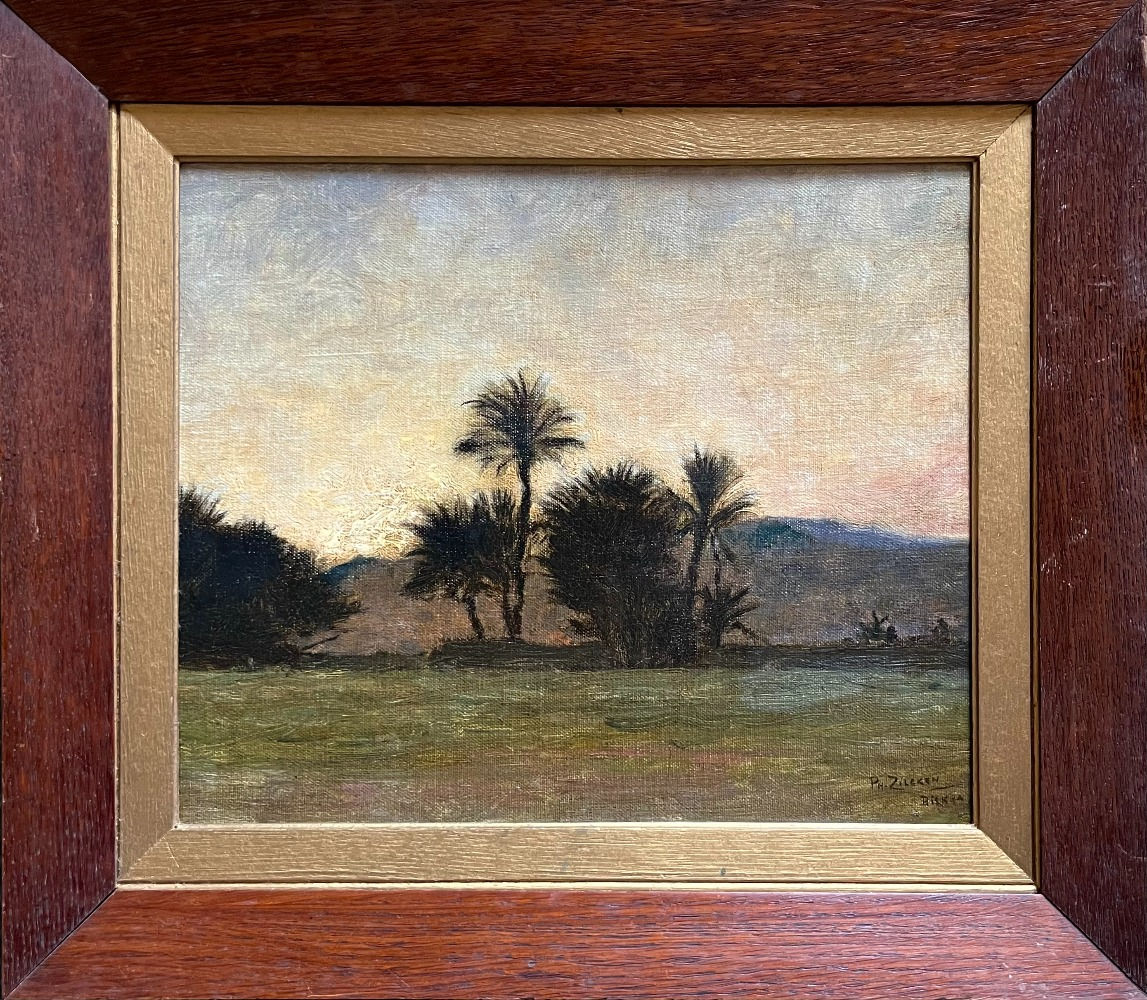

Philip Zilcken - Oasis in Biskra
Philip Zilcken (1857-1930)
Oasis in Biskra / Evening in Biskra
Oil on canvas on board
Signed lower right
26.3 x 32.4 cm
Frame: 37 x 43 cm
Provenance:
Private collection, Leiden
Additional nformation:
Charles Louis Philippe Zilcken, known as Philip, was an important Dutch artist and writer. His artistic career was marked by a strong fascination with North Africa, which, together with artists such as Marius Bauer and Hendrik Haverman, made him one of the leading Dutch Orientalists of his time.
Zilcken began his artistic training after completing secondary school at the Gymnasium Haganum, studying at the drawing academy in The Hague under Karel Klinkenberg and Anton Mauve. He was a co-founder of the Nederlandsche Etsclub and served as art editor of Elsevier’s Geïllustreerd Maandschrift from 1896 to 1905.
Zilcken was actively involved in Dutch artists’ societies and was a member of the French Société des Peintres Orientalistes. His artistic achievements were recognised with various distinctions and orders, and his influence extended beyond the Netherlands through his internationally published writings on contemporary Dutch art, which appeared in Dutch, French and English.
Zilcken’s Orientalist period began in February 1883, inspired by the travel accounts of the Goncourt brothers about their time in Algiers. His experiences in North Africa were recorded in the book “Drie maanden in Algiers”, describing his first visit to the region. During a stay in Egypt in 1914, where he initiated the establishment of a Musée d’Art Orientaliste, Zilcken produced the book “Reisindrukken”, illustrated with twelve of his etchings.
During his travels in Algeria, Zilcken also visited Biskra. Working en plein air at dusk, he painted this oasis with a strong contrast between light and dark. On the reverse, the artist wrote the title “Avond te Biskra” and noted the crate number in which the painting was shipped from North Africa to the Netherlands.
Zilcken’s Orientalist works, ranging from oil paintings to pastels and etchings, show his particular attention to Eastern architecture and nature, with people often playing a secondary role. His sketch-like approach to Orientalist printmaking, drawn and printed on location in reddish-brown ink, was distinguished by his technical skill. This work was highly successful during his lifetime, with exhibitions in New York in 1892 and a special Orientalist issue of La Gazette de Hollande in 1911.