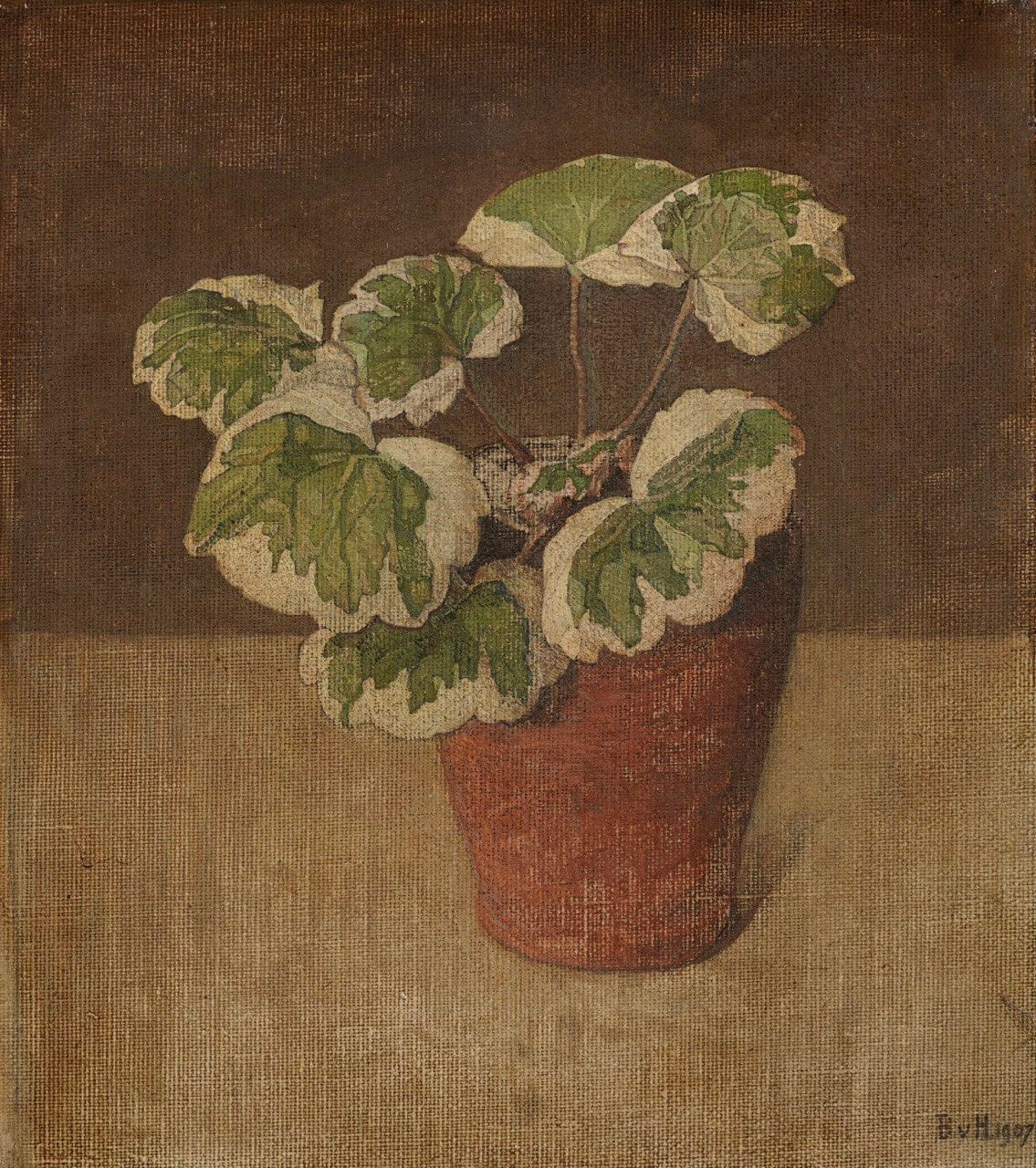
Bertha van Hasselt - Wierookplantje, 1907
Bertha van Hasselt (1878-1932)
Still life of a Plectranthus coleoides
1907
Oil on canvas
Monogrammed lower right “B.v.H 1907”
24 x 21 cm
Frame: 38 x 35.5 cm
Condition:
In authentic and good condition, checked by Museum Arnhem paintings conservator Han Boersma.
Provenance:
Private collection H.P. Bremmer;
Private collection Rudolf Bremmer 1956 (RKD inventory list);
Kunsthandel & Bemiddelingsbureau Interbellum;
Private collection, Leiden.
Exhibition:
Museum Arnhem, Jan Mankes - Verstilling en Strijd, 25 January 2025 – 24 August 2025.
Additional information:
Bertha van Hasselt (Zwolle 1878 - 1932 Nijmegen) was a Dutch painter, draughtswoman and printmaker. She trained at the Royal Academy of Art in The Hague and exhibited in 1913 at the exhibition De Vrouw 1813-1913 while living in Hees near Nijmegen.
The work above is an exemplary and very early still life in which she paints the incense plant and ceramic pot with the same refinement and precision found in her portraits. In this still life, Bertha van Hasselt uses a technique similar to that of Jan Mankes. She rubs the paint with a cloth or stone so that the texture of the canvas shows through. The paint layer becomes very thin, creating a suggestion of transparency. In the leaves of the incense plant she added fine pencil lines, contributing to the intimate character of the still life.
Her portraits, including those of Henk Bremmer, Julie de Graag and Gerard Heymans, are characterised by their restrained modesty and tenderness.
Through the artist Corrie Pabst, Van Hasselt came into contact with H.P. Bremmer. Her relationship with the “art pope” Henk Bremmer was close, and she lived and worked exclusively within Bremmer’s circle, which also became her own. She formed close friendships with Egte van Wissekerke, Jo Koster and Julie de Graag. This intimate work hung on the wall of the Bremmer family for decades, as shown by source material in the RKD.
Van Hasselt’s work was acquired by Helene Kröller-Müller for the Kröller-Müller Museum and is also represented in the collections of the Drents Museum and the Rijksmuseum Amsterdam.