Willy Sluiter and the Fight for the 1920 British Empire Heavyweight Crown

Updated: Sep 3
A few years ago, I took up BJJ. Brazilian Jiu-Jitsu is a popular form of ground fighting in which technique, timing and stamina come together. There is something deeply human about the interplay of feeling, reacting and anticipating. Johan Huizinga, the historian, called it homo ludens: man as a creature at play.
Think of tiger cubs or dogs tumbling over one another. Human beings seem to have a similar instinct. At least, a certain type of man does. We explore strength, control and boundaries through play. In BJJ, this instinct takes on a concentrated form. Using holds and chokes, you try to force your opponent into submission. I recognised that same physical game of chess, that struggle for the upper hand, in two works by Willy Sluiter that I recently acquired.

Anyone who has ever watched a boxing match featuring Tyson Fury or Rico Verhoeven will know the tension of such a fight: an evening of pumping music, tough talk, sweaty bodies, bloody noses, black eyes and the promise of eternal glory.
Around 1900, the appeal was much the same. Boxing was immensely popular, precisely because of its raw, theatrical power. At the same time, the sport was still struggling with its reputation. The Royal Albert Hall in Kensington was initially reluctant to admit boxing, as professional pugilists were considered too common for a venue of such stature.
All the more telling, then, that just a few years later, matches were being held there on a regular basis. Popularity, and the commerce that came with it, had won the day.
A Championship Bout: Joe Beckett versus Tommy Burns
It was here, at the Royal Albert Hall, that the two fighters Joe Beckett and Tommy Burns faced each other on 16 July 1920, contesting the British Empire Heavyweight Crown. Joe Beckett was the British heavyweight champion, forged in the tough circuit of travelling fairgrounds and fairground booths. Opposite him stood the 39-year-old Canadian Tommy Burns, a former world champion and an established name on the international stage. At 170 cm, he remains the shortest heavyweight champion in boxing history.
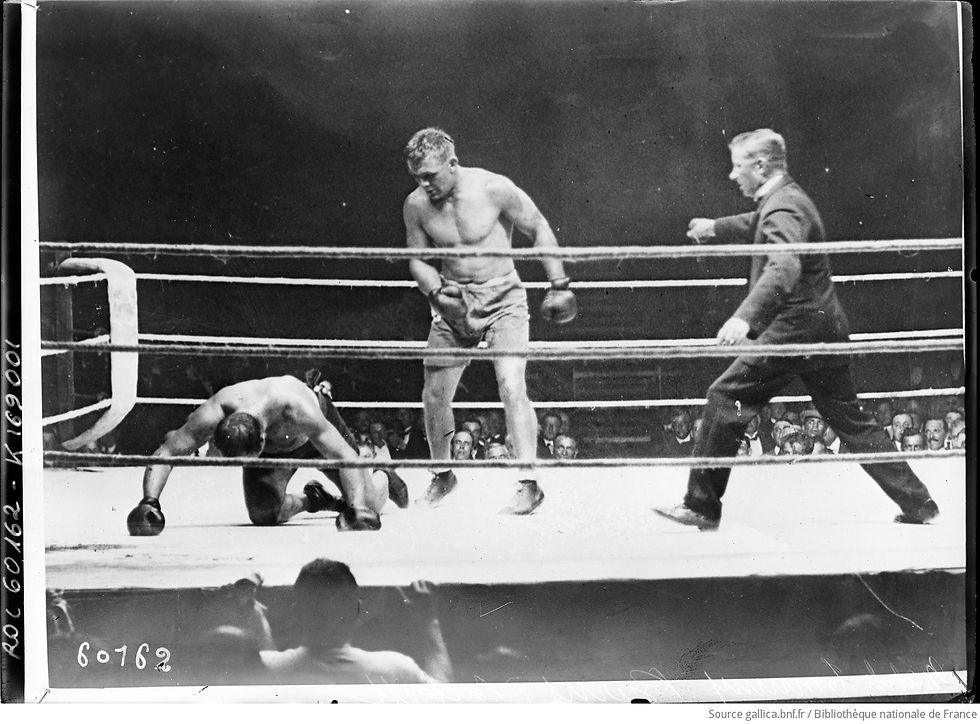
The opening rounds revealed little. Drawing on his experience, Burns disrupted the pace and kept Beckett at bay in the early stages. In the second and third rounds, he survived by clinching, though he failed to land any telling blows of his own. As the rounds progressed, Beckett took control. Burns was knocked down twice by heavy blows in the fifth and sixth rounds. The fight finally ended in the seventh, when his corner threw in the towel.

From Blow to Artwork. Who was Willy Sluiter?
In pencil, watercolour and gouache, Willy Sluiter captures the moment suprême in his diptych: Beckett stepping forward with a powerful punch, Burns retreating towards the ropes, and the audience visibly on the edge of their seats. The second work shows the aftermath. Burns is on his knees, dazed and defeated, while the referee bends over him. This would be Burns’s final fight, marking the end of his sixteen-year career in the ring.
The international press reported extensively on the bout. The New York Times headline read: “BECKETT STOPS BURNS; Forces Canadian Fighter to Throw Up Sponge In Seventh Round”. German, Italian, French and Dutch newspapers also covered the fight, with photographs, including images of the decisive blow. It therefore seems likely that Sluiter drew on these press photographs when creating the works. This would explain the cinematic immediacy of the compositions.


Willy Sluiter (1873–1949) was a Dutch painter, draughtsman and illustrator, born in Amersfoort and raised in Zwijndrecht. He studied at the Rotterdam Academy and the Rijksakademie in Amsterdam and developed into a versatile artist. From an early age, he focused on depicting modern life. He worked for newspapers and magazines, designed posters and advertisements, and was active as a painter and illustrator. Sluiter lived and worked in places including Katwijk, Scheveningen and The Hague. He also travelled abroad regularly, finding inspiration in everyday life, sport and the world of entertainment.
This subject was particularly well suited to Willy Sluiter. He had a keen eye for modern life and a talent for capturing movement, character and atmosphere with speed and humour. He did so chiefly through cartoons, illustrations and advertising, alongside a substantial body of independent drawings and paintings. His work earned him recognition both in the Netherlands and abroad. In this diptych, Willy Sluiter takes hold of sport, spectacle and human vulnerability and presents them in raw, unvarnished images.
Would you like to get even closer to this moment in the ring? This is one of the few boxing matches of its era to have been filmed. Judge for yourself whether Willy Sluiter captured the decisive moment, and whether boxing in 1920 was really so different from the sport we know today.
The moment suprême of the fight can be seen below:


